3.3.4Do you want to play a derivative game?
Ways to Describe and

Derivative Notations
In calculus, there is not a single correct notation for expressing a derivative. Instead, several different notations have been used by different mathematicians. The usefulness of each notation varies in a given context. The most common derivative notations are listed below.
Derivative functions describe the instantaneous rate of change of another function at any value of
First derivative notation:
Second derivative notation:
Higher derivatives are expressed as:
THE SILENT BOARD GAME
Do not talk! Your teacher will draw a large curve on the board. It is your job to label it as completely as possible.
WALK–A-WAVE CHALLENGE
Your teacher will give you a limited amount of time to “walk” one cycle of a perfect sine wave and record it on a motion detector. Use
THE SECOND DERIVATIVE IN MOTION PROBLEMS
If
represents the rate of change of , then what does represent? If represents velocity, then what does represent? Since concavity depends on how the slope is changing, concavity must depend on the slope of the slope. What does this mean? Explain this in your own words.
Examine the curves below and complete the table with the signs (positive or negative) of
and . The first entry has been done for you. Increasing or
Decreasing?Walking away from the
motion detector? orWalking towards the
motion detector?Concave Up or
Concave Down?Getting faster?
or
Getting slower?

Increasing
Away from motion detectorConcave up
Getting fasterpositive
positive
.png)
.png)
.png)
How does the increasing or decreasing nature of the graph of
relate to ? How about ? How does the concavity of the graph of
relate to ? How about ? In Lesson 1.4.4, you discovered that positive acceleration does not always mean that an object is speeding up, and negative acceleration does not always mean that an object is slowing down. Use the table in part (c) to determine how the graphs of
and can be used collectively to determine if a moving object is speeding up or slowing down. Explain your answer graphically. Be prepared to share your answer with the class.
Apply your conclusions from parts (d) and (e) of problem 3-126 to determine where
The Math Notes box in Lesson 3.3.2 states that a point of inflection is a point where concavity changes.
Examine the graph of
and identify where the graph changes concavity. Where is the point of inflection? What is special about
at the point of inflection? When locating a point of inflection, it is often helpful to set the second derivative equal to zero, and then solve for
. Does this always work?
Find a counterexample to the claim that inflection points exist where the second derivative has a root. That is, can you think of a function,, such that, for some value
but is not the location of a point of inflection?
Thoroughly investigate the graph of
Summarize your understanding of first and second derivatives. Include information regarding increasing, decreasing, concavity.

The graph of
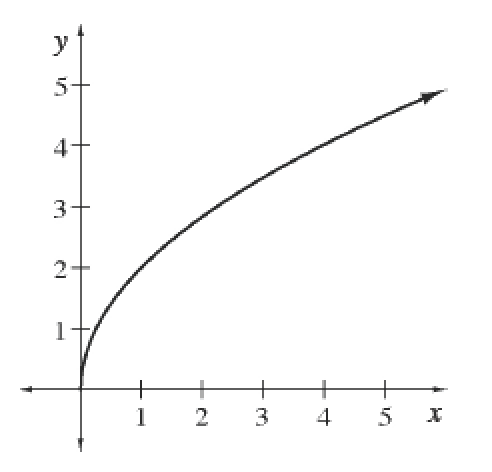
Without your calculator, write the equation of the line tangent to

If
If a function
Explain your idea using the graph at right.
Use your idea to algebraically determine where
is increasing.

Write a Riemann sum to estimate the area under the cuve for
For the absolute value function shown at right, something interesting happens to the tangent line of the function at
.png)
For each graph below: Homework Help ✎
Trace the graph onto your paper and write a slope statement for
. Sketch the graph of
using a different color.
.png)

.png)
The velocity of a roller coaster car in meters per second on a certain segment of track is represented by the function
Sketch a graph of the velocity function for
. What is the speed of the car at ? Assuming that the car is
meters above ground at , where is the car at ? How far is this drop?
Evaluate each limit. If the limit does not exist due to a vertical asymptote, then add an approach statement stating if


